
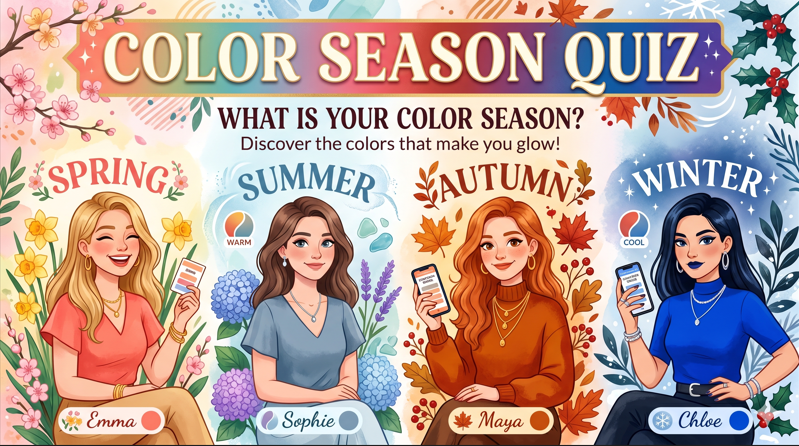
Wondering what colors look best on you? Take our ultimate color season quiz to discover your perfect palette, transform your wardrobe today.
Find Your True Palette: The Ultimate Color Season Quiz
Have you ever bought a sweater that looked absolutely stunning on the hanger, only to put it on and instantly feel washed out? We have all been there. You stare in the mirror wondering if you need more sleep or a different lighting setup. But the secret to looking vibrant, awake, and put-together rarely has anything to do with expensive skincare or chasing fleeting fashion trends. Instead, it is all about understanding the hues that naturally harmonize with your skin, hair, and eyes. That is exactly where taking a color season quiz comes in.
By identifying whether your features align with Spring, Summer, Autumn, or Winter, you can stop guessing in the fitting room and start building a wardrobe that makes you glow.
Let us break down exactly how seasonal color analysis works, why it is a game-changer for your personal style, and how you can find your perfect match right now.
What Exactly Is Seasonal Color Analysis?
Seasonal color analysis is a styling tool that matches your natural coloring to a specific palette of clothing and makeup shades. Originating in the 1980s and experiencing a massive revival on platforms like TikTok recently, this system categorizes people into four main seasons.
The concept relies on two primary factors: your undertone and your contrast level. Your undertone is the subtle hue beneath the surface of your skin, usually categorized as warm, cool, or neutral. Contrast refers to the difference in darkness or lightness between your skin, hair, and eyes.
When you wear colors that match your seasonal profile, your skin looks clearer, your eyes pop, and imperfections seem to fade. Conversely, wearing the wrong colors can cast harsh shadows, emphasize dark circles, and make you look tired.
Why You Need to Take a Color Season Quiz Today
You might be wondering if restricting yourself to a specific color palette will feel limiting. In reality, knowing your season offers incredible freedom and practical benefits.
First, it makes shopping effortless. When you walk into a store or browse online, you can immediately bypass the racks that do not serve you. You save time, money, and the frustration of returning items that just do not look right.
Second, it naturally creates a capsule wardrobe. When all the items in your closet belong to the same color family, they inherently mix and match beautifully. Getting dressed in the morning takes half the time because everything coordinates.
Finally, it boosts your confidence. There is a distinct psychological lift that happens when you know you look your absolute best. You carry yourself differently when your outfit works in perfect harmony with your natural features.
How to Determine Your Season: A Mini Color Season Quiz
Ready to figure out where you land? Grab a mirror, stand in natural daylight, and ask yourself these core questions.
Step 1: Discover Your Undertone
The foundation of any accurate color season quiz starts with your skin’s undertone. Look at the veins on the inside of your wrist.
- Do they look distinctly blue or purple? You likely have cool undertones.
- Do they look slightly greenish or olive? You likely have warm undertones.
- Can you not really tell, or do they look like a mix of both? You might be neutral.
Next, think about jewelry. Does silver make your skin look bright and clear, while gold makes you look slightly yellowish? That points to cool undertones. If gold makes you glow and silver looks stark or grayish, you lean warm.
Step 2: Evaluate Your Contrast Level
Now, look at your overall face. How much difference is there between the color of your skin, your natural hair, and your eyes?
- High Contrast: Very pale skin with dark brown or black hair, and bright jewel-toned eyes.
- Low Contrast: Light blonde hair, light skin, and pale eyes. Alternatively, deep skin, dark hair, and dark eyes. The colors tend to blend together without harsh lines.
- Medium Contrast: Ashy brown hair, medium skin, and hazel or soft brown eyes.
Breaking Down the Four Seasonal Palettes
Once you have an idea of your undertone and contrast, you can place yourself into one of the four main categories.
The Winter Palette: Cool, Deep, and Clear
Winters have cool undertones and typically high contrast. Think of snow-white skin against jet-black hair, or very deep, cool-toned skin with strikingly dark eyes.
If you are a Winter, you shine in bold, highly saturated colors. You are one of the lucky few who can rock pure black and stark white effortlessly.
- Your best colors: Emerald green, sapphire blue, true ruby red, hot pink, and icy blue.
- Colors to avoid: Earth tones like rust, mustard yellow, and muted browns, which will make you look tired.
The Spring Palette: Warm, Light, and Bright
Springs have warm undertones with a bright, clear quality to their features. They often have light to medium golden blonde, strawberry blonde, or light brown hair with bright blue or green eyes.
Springs need colors that are just as fresh and vibrant as their natural coloring.
- Your best colors: Coral, peach, golden yellow, bright aqua, and warm Kelly green.
- Colors to avoid: Dusty, muted tones and harsh dark colors like stark black or deep burgundy, which can overwhelm your delicate coloring.
The Summer Palette: Cool, Light, and Muted
Summers have cool undertones paired with low to medium contrast. Their features often have a soft, almost grayish or ashy quality. Think ash blonde or soft brunette hair with slate blue, grey, or soft hazel eyes.
Summers look incredibly elegant in soft, blended, and powdery colors.
- Your best colors: Dusty rose, powder blue, lavender, sage green, and soft navy.
- Colors to avoid: Neon colors, intense oranges, and harsh black, which will clash with your soft features.
The Autumn Palette: Warm, Deep, and Muted
Autumns have rich, warm undertones and often feature a lower contrast with a golden or fiery glow. Hair colors range from auburn and copper to deep golden brown, paired with hazel, olive, or warm brown eyes.
Autumns look breathtaking in rich, earthy tones that mimic the changing leaves.
- Your best colors: Rust red, mustard yellow, olive green, terracotta, and chocolate brown.
- Colors to avoid: Icy pastels, stark black, and cool, bright jewel tones like fuchsia or royal blue.
FAQs About Finding Your Color Season
Can my color season change as I get older? Generally, your core season remains the same throughout your life because your fundamental undertone does not change. However, as hair goes gray and skin loses some pigment, your contrast level might soften. A high-contrast True Winter might gracefully transition into a slightly softer Cool Summer palette as they age.
What if I love a color that is not in my season? Wear it anyway! The rules of a color season quiz are guidelines, not laws. If you adore a color that technically drains you, keep it away from your face. Wear it as pants, a skirt, shoes, or a handbag. You can also offset a “bad” color by wearing your best colors as a scarf or a bold lipstick right next to your face.
Can I be a mix of two seasons? Yes, this is where the 12-season or 16-season analysis comes in. If you feel like you do not perfectly fit the core four, you might be a “Soft Autumn” leaning into Summer, or a “Bright Spring” bordering on Winter. Sub-seasons offer a much more nuanced and personalized palette.
Ready to Transform Your Wardrobe?
Discovering your perfect color palette is a journey of self-expression. It stops the endless cycle of buying clothes you never wear and helps you curate a closet full of pieces that make you feel incredible.
Whether you are a vibrant Spring, a sultry Autumn, a crisp Winter, or a delicate Summer, embracing your natural harmony is the ultimate style hack. Take what you have learned from this color season quiz, head to your closet, and start experimenting with the hues that were literally made for you. Your most radiant self is just a wardrobe shift away.
Embrace Your Most Radiant Self
Unlocking your seasonal color palette is more than just a fashion trend; it is a powerful tool for self-discovery and confidence. By aligning your wardrobe with the natural undertones of your skin, hair, and eyes, you transition from simply wearing clothes to wearing colors that truly celebrate you.
Key Takeaways for Your Style Journey
- Shopping with Purpose: Say goodbye to “closet orphans”—those items that look great in the store but never leave your wardrobe. Now, you can shop with a curated eye, selecting pieces that are guaranteed to make you glow.
- Effortless Coordination: Building a capsule wardrobe becomes second nature when your clothes belong to the same harmonious family. Mixing and matching is no longer a chore; it is a creative joy.
- Authentic Confidence: There is an undeniable power in knowing your best colors. When you wear what harmonizes with your natural beauty, you project a sense of ease and vibrancy that others will definitely notice.
Your Next Steps
Don’t feel pressured to replace your entire closet overnight. Start small by experimenting with accessories or makeup in your seasonal shades and notice the difference in the mirror. Style is a continuous evolution, and understanding your palette is the compass that ensures you are always headed in the right direction.
The most beautiful color in the world is the one that looks good on you. So, take these insights, trust your intuition, and step into the world with a wardrobe that is as bright and unique as you are.