
Navigating the Minnesota window tint law change for 2026? New permanent medical exemptions, VLT limits, and how to stay legal on MN roads.
Minnesota Window Tint Law Change: Everything You Need to Know for 2026
If you’ve spent any time driving through the Land of 10,000 Lakes, you know that our weather is anything but consistent. From blinding snow glare in January to the high-noon sun of July, window tint isn’t just about looking cool—it’s about comfort and safety. However, Minnesota has historically been one of the stricter states when it comes to how dark you can go.
Recently, there has been a significant Minnesota window tint law change that specifically impacts how drivers with medical conditions handle their exemptions. If you’ve been frustrated by the need to renew your doctor’s note every two years, or if you’re just trying to figure out if your new SUV is “street legal,” you’re in the right place.
In this guide, we’re breaking down the 2026 regulations, the new permanent medical status, and the specific VLT percentages you need to follow to avoid a “fix-it” ticket.
The Big Change: Permanent Medical Exemptions
The most notable update coming into full effect for 2026 involves the medical exemption process. Previously, Minnesota drivers with conditions like lupus, light sensitivity, or extreme photosensitivity had to jump through hoops every 24 months to keep their darker tint legal.
No More Two-Year Renewals
Under the new legislation (clarified in recent sessions by lawmakers like Senator Jeff Howe), if a physician determines that your medical condition is permanent, your tint exemption is now permanent too. You no longer need to schedule a doctor’s appointment every two years just to prove you still need protection from UV rays.
Who Can Sign Your Prescription?
A common point of confusion has been exactly which medical professionals can authorize this. The 2026 updates clarify that optometrists are explicitly authorized to provide these prescriptions, alongside traditional physicians. This is a huge win for those dealing with traumatic brain injuries (TBI) or specific vision-related light sensitivity who primarily see eye specialists.
Pro-Tip: Your prescription must still specifically state the minimum light transmittance percentage required for your health. Simply having a “note from a doctor” isn’t enough; the law requires the specific VLT (Visible Light Transmission) limit to be listed.
Current Minnesota Window Tint Limits for 2026
While the medical side of the law has softened, the general VLT limits for the average driver remain firm. Minnesota uses a “NET” measurement, meaning the limit applies to the combined darkness of the glass and the film.
VLT Requirements by Vehicle Type
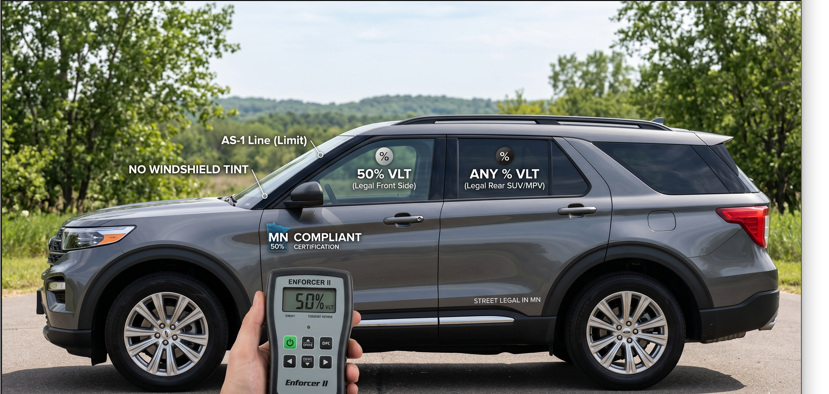
| Window Location | Passenger Cars (Sedans, Coupes) | MPVs (SUVs, Vans, Trucks) |
| Windshield | No tint allowed (AS-1 line only) | No tint allowed (AS-1 line only) |
| Front Side Windows | 50% VLT or lighter | 50% VLT or lighter |
| Back Side Windows | 50% VLT or lighter | Any darkness allowed |
| Rear Windshield | 50% VLT or lighter | Any darkness allowed |
The “SUV Loophole”
You might notice that SUVs and Vans (Multi-Purpose Vehicles) have much more freedom. In Minnesota, if your vehicle is classified as an MPV, you can “black out” the rear windows as dark as you’d like. However, if you drive a standard Toyota Camry or Honda Civic, you are legally restricted to 50% on every window.
This is a common point of frustration for sedan owners, but for now, the Minnesota window tint law change hasn’t moved the needle on these specific percentages.
Why 50%? Understanding the Safety Standards
You might be wondering why Minnesota is so stuck on 50% VLT when neighboring states allow 35% or even 20%. The state’s primary concern is officer safety and nighttime visibility.
At 50%, a police officer can still see the silhouette of a driver during a traffic stop. In a state with long winter nights and frequent heavy snowfall, maintaining clear visibility through the side windows is a top priority for the Department of Public Safety.
Reflectivity and Color Restrictions
It’s not just about how dark the windows are; it’s also about how much they act like a mirror.
- Reflectivity: In Minnesota, your tint cannot be more than 20% reflective. This means those “chrome” or “mirrored” tints are a no-go. They can cause dangerous glares for other drivers, especially during the sunset hours.
- Colors: Minnesota law prohibits the use of any tint that is strikingly red, yellow, or amber. Stick to standard smoke, charcoal, or ceramic films to stay within the lines.
How to Stay Compliant: The Sticker Rule
One part of the law that many people forget is the certification requirement. According to Minnesota Statute 169.71, any aftermarket tint applied must have a permanent marking.
Most professional shops in the Twin Cities or Rochester will automatically apply a small sticker between the film and the glass (usually on the driver’s side window). This sticker identifies that the film is compliant with Minnesota’s VLT and reflectance standards. If you’re doing a DIY tint job, make sure your kit includes these legal identifiers, or you might find yourself explaining it to a State Trooper.
Test Your Knowledge: The Minnesota Window Tint Law Quiz
To ensure you’re fully up to speed with these 2026 updates, we’ve put together a quick Minnesota window tint law quiz to test your knowledge. Whether you are a long-time resident or just moved to the state, taking a moment to run through these questions can help you verify if your current vehicle setup meets the new standards. This interactive quiz covers everything from VLT percentages for different vehicle classes to the specific requirements for permanent medical exemptions. Don’t risk a “fix-it” ticket—take the quiz below and see if you’re a pro on the latest North Star State road rules.
Frequently Asked Questions (FAQ)
1. Can I tint my windshield in Minnesota?
Generally, no. You are only allowed to tint the top portion of the windshield down to the AS-1 line (usually about 4 to 6 inches from the top). The only exception is if you have a documented medical waiver.
2. What is the fine for illegal window tint in MN?
Fines vary by county, but a window tint violation is typically a petty misdemeanor. Including court fees, you can expect to pay anywhere from $130 to over $200. Often, these are “fix-it” tickets, meaning the fine may be reduced if you prove you’ve removed the tint.
3. Does the law apply to out-of-state drivers?
Yes. If you are driving on Minnesota roads, you are expected to follow Minnesota’s equipment laws. While many officers will give out-of-state plates a pass on minor tint infractions, they technically have the right to cite you if your tint is excessively dark.
4. What counts as a medical condition for tint?
Commonly accepted conditions include:
- Lupus (Systemic Lupus Erythematosus)
- Albinism
- Porphyria
- Severe Eczema or Photosensitivity
- Traumatic Brain Injury (TBI) resulting in light-induced migraines
Actionable Tips for Minnesota Drivers
If you’re looking to upgrade your ride’s glass in 2026, keep these steps in mind:
- Check Your Door Jamb: Look at the manufacturer’s sticker to see if your vehicle is classified as a “Passenger Car” or “MPV.” This determines how dark your back windows can go.
- Choose Ceramic Film: Since Minnesota limits you to 50% VLT, you won’t get much privacy. However, a high-quality ceramic tint can block up to 99% of UV rays and significant infrared heat even at a lighter shade.
- Keep Your Paperwork: If you have a medical exemption, keep a copy of your prescription in your glove box at all times. The 2026 law makes it permanent, but you still need to show proof if pulled over.
- Ask for the Meter: Before leaving the tint shop, ask the technician to use a “tint meter” on your window. This ensures that the combination of the film and your factory glass (which usually has a slight 70% tint from the factory) doesn’t drop you below the legal 50% limit.
Conclusion
Staying on top of the minnesota window tint law change is essential for any car enthusiast or daily commuter in the state. The move toward permanent medical exemptions is a compassionate step forward for those who truly need protection from the sun, but for the rest of us, the 50% rule remains the standard.
By choosing high-quality films and ensuring your vehicle stays within the VLT and reflectivity limits, you can enjoy a cooler, safer drive without the headache of legal trouble. Whether you’re cruising through Minneapolis or heading up to the North Shore, keep it legal, keep it clear, and enjoy the ride!