
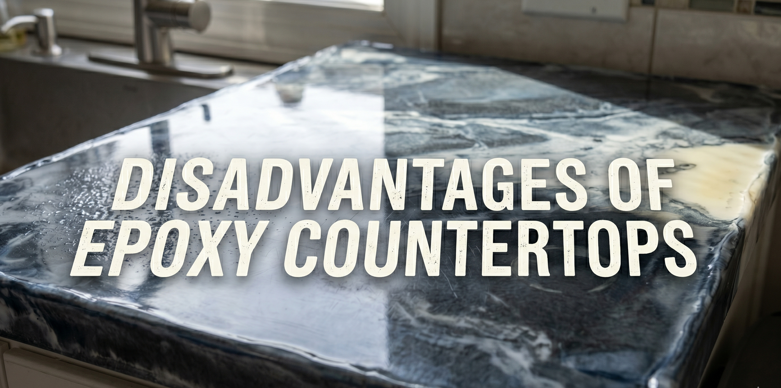
Learn the major disadvantages of epoxy countertops. From heat sensitivity to difficult DIY installs, we cover the risks of this glossy finish
The Hidden Downside of Gloss: Disadvantages of Epoxy Countertops You Need to Know
If you’ve spent any time on home renovation forums or Pinterest lately, you’ve likely seen the mesmerizing “pour” videos of epoxy countertops. They’re glossy, they’re seamless, and they can make a $50 laminate slab look like $5,000 Italian marble. It’s easy to get swept up in the aesthetic, but before you buy your resin kit, it’s vital to talk about the reality of living with them.
While epoxy offers a unique, high-end look without the demolition of a full remodel, it isn’t a magical solution for every kitchen. Like any specialized material, it comes with a specific set of trade-offs. From tricky installations that offer “no second chances” to surprising sensitivities to everyday kitchen heat, the disadvantages of epoxy countertops can be a dealbreaker for many homeowners.
In this guide, we’re going to peel back the high-gloss finish and look at the functional risks, maintenance headaches, and long-term durability issues you should consider before making the commitment.
1. The “One Shot” Installation Nightmare
One of the biggest functional disadvantages of epoxy countertops is the sheer difficulty of the application. Unlike wood or stone, where you can sand down a mistake or trim an edge, epoxy is an “all or nothing” game.
- No Second Chances: Once you mix the resin and hardener, the chemical clock starts ticking. If you apply it unevenly or wait too long, it will cure with ridges, lumps, or bare spots.
- Irreversible Errors: If you make a significant mistake during the pour, there is no easy way to “undo” it. In many cases, you have to rip out the entire countertop and start over from scratch.
- The Mess Factor: Epoxy is a liquid. It drips. It runs. It sticks to everything. Protecting your floors and cabinets requires meticulous prep work that often takes longer than the actual pour.
2. Heat Sensitivity: A Major Kitchen Risk
While we often think of “hard” surfaces as being heat-proof, epoxy is essentially a type of plastic. This leads to one of its most frustrating downsides: it can be quite sensitive to temperature.
Most standard epoxy resins only have a peak heat resistance of around 135°F (57°C) once fully cured. For context, a pot of boiling water is 212°F. If you set a hot pan directly on your counter, you aren’t just risking a slight mark—you are looking at potential warping, softening, or permanent discoloration. You must be diligent about using trivets and hot pads, which can take away from the “carefree” feel of a modern kitchen.
3. The “Yellowing” Effect Over Time
Every homeowner wants their counters to look as good in year ten as they did on day one. Unfortunately, epoxy has a natural enemy: UV light.
Over time, exposure to sunlight—even through a window—can cause the clear resin to undergo a chemical change called “ambering” or yellowing. While some high-grade resins include UV inhibitors, almost all epoxy will eventually take on a yellowish tint if exposed to consistent light. This is particularly noticeable and unsightly on white or “marble-look” designs.
4. Maintenance and Durability Comparison
How does epoxy stack up against the heavy hitters of the countertop world? While it is non-porous and easy to wipe down, its long-term durability has some significant gaps.
| Feature | Epoxy Countertop | Granite | Quartz |
| Heat Resistance | Low (Up to 135°F) | Very High | Moderate/High |
| Scratch Resistance | Moderate (Prone to metal marks) | High | High |
| UV Stability | Poor (Yellows over time) | High | High |
| Maintenance | Mild soap only | Requires sealing | Low (No sealing) |
| Repairability | Hard (Requires new coat) | Easy (Buffing/Filling) | Moderate |
As shown, while epoxy is competitive in terms of moisture resistance, it falls behind in the categories that matter most for high-traffic kitchens: heat and scratch resistance.
5. Health and Environmental Concerns
Working with epoxy involves a chemical reaction, and that process isn’t exactly “green.” This is a significant point for those who prioritize eco-friendly home materials.
- VOC Emissions: During the mixing and curing process, epoxy emits Volatile Organic Compounds (VOCs). These can cause headaches, dizziness, and respiratory irritation if the area isn’t perfectly ventilated.
- Sustainability: Epoxy is a non-biodegradable, non-recyclable plastic polymer. Once it’s on your counters, it stays in the environment forever.
- Skin Irritation: The liquid resin can be a sensitizer. If it gets on your skin, it can cause severe allergic reactions or dermatitis, requiring full protective gear (gloves, masks, and long sleeves) during installation.
6. The “Bubble” and “Dust” Trap
In those satisfying time-lapse videos, the epoxy looks like a perfect sheet of glass. In reality, your home is full of dust, pet hair, and air bubbles.
- Bubbles: As the two parts react, they generate heat and release air. If you don’t use a heat gun or torch correctly to “pop” these bubbles as they rise, they will cure into the surface, leaving tiny, permanent craters.
- Debris: Because epoxy takes hours to “tack up” and days to fully cure, any dust or hair that falls into it during that time becomes a permanent part of your countertop. Achieving a truly “flawless” finish in a standard home environment is incredibly difficult.
7. Difficulty in Mimicking Natural Materials
While marketing photos often show stunning “faux marble,” achieving that look is an art form. For a beginner, trying to recreate the deep, authentic veining of natural stone often results in a finish that looks… well, like paint swirled in plastic. If you want a truly realistic stone look, the labor costs for a professional artist can quickly make epoxy as expensive as real granite or quartz.
Common Questions About Epoxy Downsides (FAQ)
Can I cut directly on an epoxy countertop?
No. While the surface is hard, it is not scratch-proof. A sharp kitchen knife will leave permanent gouges in the resin. You must always use a cutting board.
Is it hard to repair scratches in epoxy?
Yes, it is surprisingly difficult. Unlike stone, which can be buffed, or wood, which can be sanded, a deep scratch in epoxy often requires you to sand the entire surface and pour a whole new “flood coat” to make it look seamless again.
Do epoxy countertops devalue my home?
This is subjective. While a well-done professional job can add value, a DIY project that looks “homemade” or shows signs of yellowing can actually be a deterrent for buyers who would prefer the permanence of natural stone.
Final Thoughts: Is Epoxy Right for You?
The disadvantages of epoxy countertops don’t mean you should never use them. They mean you should use them for the right reasons. If you have a low-traffic bar area, a basement workshop, or a rental property that needs a quick, non-porous face-lift, epoxy is a fantastic choice.
However, if you are a serious home cook who moves hot pans quickly and expects a surface to last 25 years without changing color, you might find the maintenance of epoxy more frustrating than it’s worth.
Before you start your project, consider the environment of your kitchen. If you have lots of natural light and high heat, you might be better off saving for a more durable slab of quartz or granite.
Ultimately, knowing these disadvantages allows you to make an informed decision. Luxury is about more than just a glossy look—it’s about how that surface serves your life every day.