
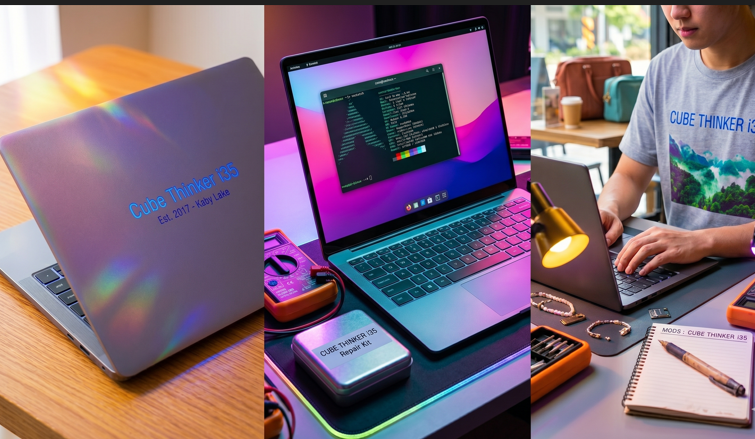
The 2026 Cult of the Cube Thinker i35: A Window to the Past, Competitive in the Future
Cube Thinker i35 has power to beat modern laptops. Explore its display, Linux potential, and why “Surface killer” has cult following in 2026.
In the mid-2010s, a quiet revolution was happening in the Chinese “white-label” laptop market. While giants like Microsoft were commanding premium LTV (Lifetime Value) with their Surface line, a challenger emerged from the Shenzhen ecosystem: the Cube Thinker i35 (now often branded under Alldocube).
For tech journalists covering the Series B era of mobile computing, the i35 was an anomaly. It didn’t just copy the competition; it borrowed arguably the best part of the Microsoft Surface Book—its display—and shoved it into a fanless, magnesium-alloy chassis for a fraction of the cost. But in 2026, does this “Kaby Lake” relic still offer Information Gain for the modern power user, or is it merely e-waste?
1. The Crown Jewel: A Display That Punches Above Its Weight
The headline feature of the Cube Thinker i35 is undoubtedly its 13.5-inch 3K IPS touchscreen. Boasting a 3000 x 2000 resolution and a productivity-friendly 3:2 aspect ratio, it was—and in many ways still is—stunning.
- Pixel Density: At 267 PPI, text is incredibly crisp, rivaling modern “Retina” standards.
- The Surface Connection: It reportedly uses the exact same Panasonic-made panel found in the original Surface Book.
- Lamination: Unlike cheaper clones of the era, the display is fully laminated, reducing the air gap between the glass and the LCD for better contrast and fewer reflections.
2. Under the Hood: The Fanless Paradox
The i35 is powered by the Intel Core m3-7Y30 (Kaby Lake). In an industry where “more cores” is the standard CAC (Customer Acquisition Cost) driver, the m3 was a deliberate choice for a silent, fanless experience.
Performance vs. Portability
The m3-7Y30 is a dual-core chip that sips power at a 4.5W TDP. While it won’t handle 4K video editing, its Speed-Shift technology allows for snappy bursts during web browsing and document editing.
| Component | Specification | Modern Context |
| CPU | Intel Core m3-7Y30 (up to 2.6GHz) | Great for light office/web |
| GPU | Intel HD Graphics 615 | Supports H.265/VP9 decoding |
| RAM | 8GB LPDDR3 | The bare minimum for 2026 |
| Storage | 256GB SATA SSD | User-replaceable (M.2 2280) |
3. The Linux Angle: A Second Life for Legacy Hardware
One area where the i35 shines for modern enthusiasts is Linux compatibility. Because it uses standard Intel components for Wi-Fi (Intel AC 3165) and graphics, it is a favorite for those looking to ditch Windows.
- Distro Success: Users have reported excellent results with Manjaro and Ubuntu Budgie, though some tweaks to the audio drivers may be required to stop speaker “popping”.
- HiDPI Support: Modern Linux desktop environments (GNOME, KDE) handle the 3000 x 2000 resolution far better than the version of Windows 10 that originally shipped with the device.
4. Design & Build: Magnesium Alloy Realities
The chassis is a “posh” magnesium alloy that feels remarkably dense like Porsche Macan 2026. At 1.69kg, it’s heavier than it looks, largely due to the glass-covered display and all-metal body.
The Good, The Bad, and The “Clacky”
- Minimalist Branding: Outside of a small logo on the lid, the device is refreshingly devoid of “gamer” aesthetics.
- The Keyboard Caveat: While the build is solid, the keyboard is often cited as the weak point—lacking a backlight and feeling “cheap” compared to the premium exterior.
- Port Selection: It lacks HDMI but compensates with two USB 3.0 Type-A ports and a USB Type-C port that supports charging and data transfer.
5. Is it Still “Helpful” in 2026?
The Cube Thinker i35 was a “Seed Funding” dream—a device that tried to bring luxury hardware to the masses. Today, it serves as a specialized tool. If you are a writer who demands a 3:2 aspect ratio for vertical screen real estate, or a developer looking for a silent Linux machine with a gorgeous screen, the i35 is a unique secondary device.
However, the 50Whr battery was mediocre even at launch, and aging cells mean you’ll likely be tethered to a wall outlet.
Final Verdict: The Specialist’s Choice
The Cube Thinker i35 remains a testament to what “white-label” manufacturers can achieve when they prioritize the user’s visual experience. It’s not a powerhouse, but it is a piece of tech history that still looks better than many budget laptops sold today.