
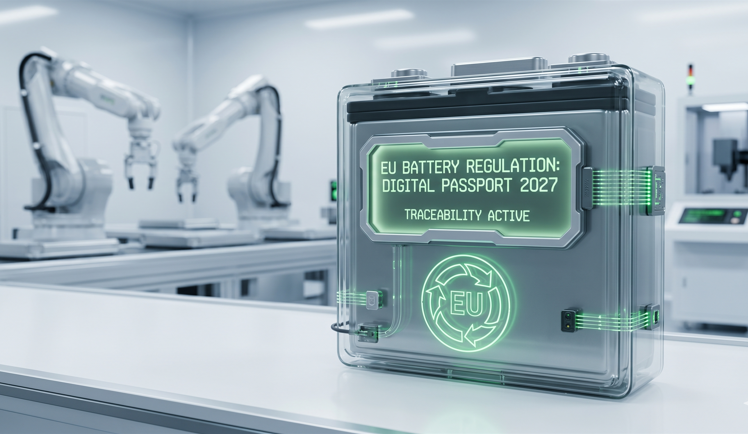
Stay ahead of the curve with the latest EU battery regulation news today. Discover how the May 2026 updates to removability exemptions.
The 2027 Digital Battery Passport, and new carbon reporting mandates are transforming the global supply chain. For years, the European Union’s Circular Economy Action Plan felt like a distant compliance horizon. But as of May 2026, the “wait and see” period is officially over. If you are an OEM, a battery manufacturer, or a tech hardware lead, the legislative landscape shifted beneath your feet this week.
Between the European Commission’s fresh consultation on removability exemptions and the looming 2027 deadline for the Digital Battery Passport (DBP), the industry is moving from theoretical sustainability to hard-coded data enforcement.
This isn’t just about “going green”—it’s about the legal right to stay on the European market. Here is the deep dive into the EU battery regulation news today that your C-suite needs to understand.
The May 2026 Update: New Exemptions for “Un-fixable” Tech
As of April 28, 2026, the European Commission launched a critical public consultation that marks a temporary win for specific hardware niches. Under the core Regulation (EU) 2023/1542, the default rule is clear: portable batteries must be removable and replaceable by the end-user.
However, the Commission is now proposing six new product categories for exemptions. If your hardware falls into these buckets, you may only need to ensure the battery is replaceable by independent professionals, rather than the average consumer:
- Wearables: Smartwatches and fitness trackers (where water-tight integrity is paramount).
- Medical Devices: High-stakes health monitors.
- Electric Toys: Ensuring safety and preventing small-cell ingestion.
- ATEX Equipment: Tools used in explosive atmospheres (explosion-proof motors).
- Wet Appliances: Electric toothbrushes and water flossers.
The Strategic Takeaway: The consultation closes on May 26, 2026. If you are a product designer in these sectors, this is your final window to influence the “Delegated Act” that will define your 2027 manufacturing requirements.
The 2026 Reality: Industrial Carbon Reporting is Live
While many are focused on the 2027 “Passport,” the Industrial Carbon Footprint mandate is already active. As of early 2026, any industrial battery or EV battery sold in the EU must have a verified carbon footprint declaration.
Gone are the days of “estimated” emissions based on industry averages. The EU now requires site-specific primary data. This means your Tier 3 and Tier 4 suppliers—the mines in Chile or the refineries in Indonesia—must provide granular energy consumption data.
2026 Compliance Checklist for Manufacturers
| Requirement | Deadline | Impacted Stakeholders |
| Manufacturer Re-registration | January 15, 2026 | All Battery Producers |
| Carbon Footprint Declaration | Active Now | EV & Industrial (>2 kWh) |
| Extended Labeling | August 18, 2026 | All Portable & LMT Batteries |
| Digital Battery Passport | February 18, 2027 | EV, LMT, & Industrial (>2 kWh) |
The Digital Battery Passport (DBP): More Than Just a QR Code
We are less than a year away from February 18, 2027—the day the Digital Battery Passport becomes mandatory. In my recent conversations with supply chain auditors, the consensus is that most firms are still treating the DBP as a “labeling task.” It is not. It is a data integration task.
A DBP is a dynamic “digital twin” of every individual battery. To comply, your Battery Management System (BMS) must be able to push real-time data to a cloud-based registry.
Key Data Points the DBP Must Track:
- Material Composition: Gram-for-gram breakdown of Cobalt, Lithium, Nickel, and Lead.
- State of Health (SoH): Real-time remaining capacity to facilitate second-life usage (e.g., turning an old EV battery into a home energy storage unit).
- Recycled Content: Proving the “circularity” of the materials used.
- Due Diligence: Proof that the cobalt in your cells wasn’t mined using child labor.
Expert Insight: The EU has postponed certain Due Diligence obligations to August 2027 (via Regulation 2025/1561), but don’t let that lull you into a false sense of security. Building a transparent supply chain for minerals takes 18–24 months of auditing. If you haven’t started, you are already behind.
Supply Chain Shockwaves: The Global Impact
The EU is the first major economy to regulate batteries this strictly, but it won’t be the last. We are seeing a “Brussels Effect” where global manufacturers are standardizing their entire global production to EU levels to avoid maintaining two separate supply chains.
1. The Rise of “Black Mass” Reporting
Recyclers are now under the microscope. The EU has recently harmonized how “black mass” (the crushed remains of batteries) is measured. By late 2027, the standard shifts from “total weight collected” to Material Recovery Efficiency.
- Lithium Recovery Target: 50% (rising to 80% by 2031).
- Cobalt/Copper/Nickel Target: 90%.
2. Geopolitical Resilience
The EU Critical Raw Materials Act is working in tandem with the battery regulation. With the creation of the European Critical Raw Materials Centre in 2026, the EU is now actively stockpiling and coordinating joint purchases to reduce dependency on single-source suppliers (primarily China).
How to Avoid the “Compliance Moat”
Small to mid-sized OEMs are at risk of being priced out of the market by the sheer cost of compliance. To survive, you must move beyond manual spreadsheets.
- Audit Your Tier 3 Suppliers: Self-declarations will not survive a 2026 third-party audit. You need verified data.
- Adopt “Traceability-as-a-Service”: Platforms like Circularise or specialty ERP modules are no longer optional. They are the only way to manage the 18-month lead time required for DBP implementation.
- Design for Disassembly: If the May 2026 exemptions taught us anything, it’s that the EU favors repairability. Designing a product that is easy to fix isn’t just good PR—it’s a regulatory hedge.
Final Thoughts: The Road to 2027
The EU Battery Regulation is the most ambitious piece of environmental industrial policy in a generation. It essentially treats a battery not as a “part,” but as a serviceable asset with a birth certificate, a resume, and a retirement plan.
By the time the Digital Battery Passport becomes the law of the land in February 2027, the companies that succeed will be those that viewed this not as a legal hurdle, but as a chance to master their data. In 2026, data is the new lithium.
FAQ: EU Battery Regulation News Today
Q: Does my small portable power station need a Battery Passport?
A: If it is classified as an industrial battery and has a capacity over 2 kWh, yes. If it is under 2 kWh and portable, it must follow the new labeling and removability rules, but not the full DBP—yet.
Q: What happens if I don’t register by the 2026 deadlines?
A: In many member states, like Germany, your existing registration will be voided. You will be legally barred from “placing on the market,” which can lead to immediate stop-sell orders and heavy fines based on turnover.
Q: Are there exemptions for small businesses?
A: While collection targets apply to everyone, strict due diligence obligations generally target companies with an annual turnover exceeding €40 million. However, larger OEMs will likely require their smaller suppliers to meet these standards anyway to maintain their own compliance.