
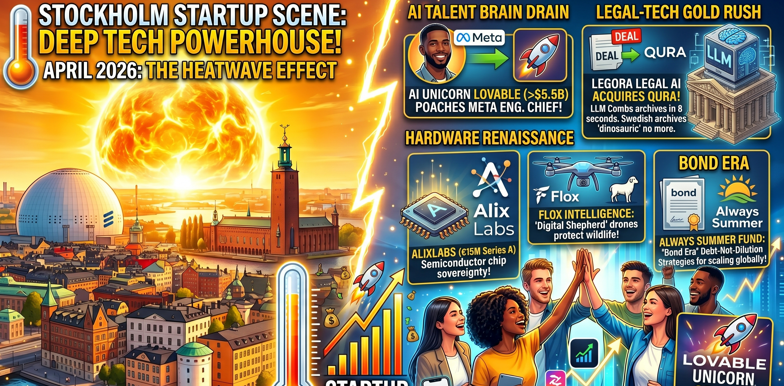
If you’ve been watching the Stockholm skyline lately, it’s not just the northern lights getting attention—it’s the glowing valuations and high-stakes M&A activity. As we move through the second quarter of 2026, the Swedish startup ecosystem is proving that it has successfully pivoted from “Fintech-first” to a “DeepTech & AI” powerhouse.
From massive legal-tech acquisitions to the return of Big Tech talent, here is the essential Sweden startup news you need to know this month.
1. The AI Talent “Reverse Brain Drain”
The headline story of April 2026 isn’t just about money; it’s about people. In a move that shocked many in the industry, the Swedish AI unicorn Lovable (now valued at over $5.5 billion) recently poached its new engineering chief directly from Meta.
This signals a massive shift: Swedish founders are no longer losing their best talent to Silicon Valley. Instead, the “Stockholm effect”—a combination of high-stakes innovation and the world-renowned Swedish work-life balance—is drawing elite engineers back to the Nordics. When Meta and Google veterans start moving to Stockholm to build the future of no-code AI, the rest of the world should take notice.
2. Legal-Tech is the New Gold Rush
The biggest deal of the week landed on April 23rd, when the Swedish legal-tech giant Legora acquired the AI-native legal research startup Qura.
Qura, a company founded by university dropouts who realized Swedish legal databases were “dinosauric,” has built an LLM-based system that can comb through decades of legal archives in eight seconds. Legora’s acquisition (following their own massive $550 million Series D earlier this year) shows that AI is moving past “chatbots” and into the heavy lifting of industry-specific data.
3. Beyond Software: The Hardware Renaissance
Sweden is proving it can build physical things just as well as code. Several hardware and “DeepTech” startups have secured major wins this month:
- Semiconductors: AlixLabs (based in Gothenburg) just closed a €15 million Series A to scale their “atomic-level etching” technology. As Europe races for chip sovereignty, AlixLabs is positioning Sweden as a critical node in the global semiconductor supply chain.
- The “Digital Shepherd”: Flox Intelligence is making waves with their AI-guided drones that act as “digital shepherds,” keeping wildlife away from dangerous areas like train tracks and airports. It’s a uniquely Swedish blend of high-tech and environmental stewardship.
- Green Energy: Aira continues its explosive growth, now ranking as a top three player in the Swedish energy-tech space. Their mission to swap every gas boiler in Europe for a Swedish-designed heat pump is gaining massive momentum with investors.
4. Venture Capital Trends: The “Bond” Era
We are seeing a fascinating shift in how Swedish scaleups are being funded. This month, former partners from Creandum (the VCs who backed Spotify) launched Always Summer, a new fund specifically designed to help startups raise capital through bonds rather than just equity.
Following the success of Voi (the e-scooter giant) raising €90 million via bonds, more Swedish companies are looking for “debt-not-dilution” strategies to keep control of their companies while scaling globally.
Why Sweden Stays at the Top in 2026
Looking at the data from April 2026, Sweden’s success isn’t an accident. It’s a result of a highly interconnected ecosystem where:
- Collaboration is the Default: Whether it’s Saab opening its doors to defense-tech startups or Klarna veterans mentoring the next generation, the “pay it forward” culture in Stockholm is unmatched.
- Sustainability as a Feature: You cannot launch a startup in Sweden today without a “Green Transition” plan. From cow-methane reduction (Volta Greentech) to ethical pet insurtech (Lassie), Swedish tech is inherently purpose-driven.
Final Thoughts
The “Sweden Startup News” for April 2026 tells a clear story: the country has matured. It is no longer a factory for “cool apps.” It is a hub for the foundational technologies—AI infrastructure, sustainable energy, and advanced hardware—that will define the next fifty years of global progress.