
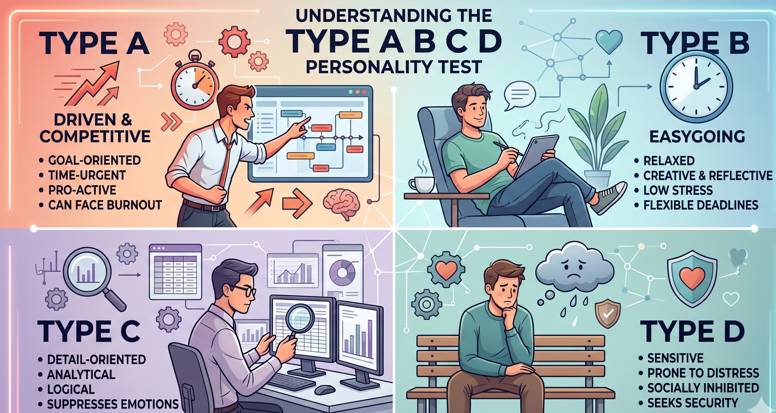
Curious about Type A B C D personality test? Discover how these four distinct psychological profiles impact your stress and relationships.
Ever felt like you are running on a different internal clock than everyone else? Maybe you are the person who arrives fifteen minutes early to every meeting, tapping your foot in frustration when others wander in late. Or perhaps you are the calm center of the storm, completely unfazed by a looming deadline that has your coworkers in a state of sheer panic.
We love putting ourselves into categories. It is human nature to want a framework that explains our quirks, our triggers, and our habits. While you might be familiar with Myers-Briggs or the Enneagram, one of the most practical tools for understanding everyday behavior is the Type A B C D personality test.
Originating from cardiological research and expanding into decades of behavioral psychology, this four-letter framework offers a remarkably accurate mirror for how we handle stress, communication, and work. Let us break down what this personality model actually means, explore each distinct type, and help you figure out where you fit on the spectrum.
What is the Type A B C D Personality Test?
At its core, the Type A B C D personality test is a psychological framework that groups human behavior into four primary patterns. Unlike abstract personality models that focus heavily on your inner fantasy life or philosophical values, this specific system looks closely at how you react to pressure, how you interact with colleagues, and how you process negative emotions.
The History Behind the Letters
The story of this personality model did not start in a psychologist’s office. It actually started in a cardiologist’s waiting room in the 1950s.
Two medical researchers, Meyer Friedman and Ray Rosenman, noticed something bizarre about their chairs. The upholstery was only worn down on the very front edge of the seats and the armrests. Their patients were literally sitting on the edge of their seats, ready to jump up at any second.
This observation led to their groundbreaking study on Type A behavior and its links to coronary heart disease, published in the Journal of the American Medical Association. Over the subsequent decades, researchers realized that while Type A described highly competitive, stressed individuals, there was an entire spectrum of people who did not fit that mold. Thus, Types B, C, and D were gradually identified and studied to create the complete matrix we use today.
Decoding the Four Profiles: Which One Are You?
No one is 100% one single letter. Human beings are nuanced, and we tend to shift based on our environment. However, most of us have a dominant baseline response that dictates our daily actions. Let us look at each profile in depth.
Type A: The Driven Overachiever
If you have ever been called a perfectionist, a workaholic, or fiercely competitive, you are likely a Type A individual. These people are the engines of the corporate world, constantly pushing for higher results and faster turnaround times.
- Core Characteristics: Time-urgency, high competitiveness, strong organizational skills, and a relentless drive for success.
- The Bright Side: They get things done. Type A individuals make incredible leaders, project managers, and entrepreneurs because they are deeply self-motivated and goal-oriented.
- The Shadow Side: They are highly prone to burnout. Because their self-worth is often tied to achievement, they struggle to relax and can become hostile or impatient when things do not go according to plan.
Type B: The Grounded Realist
Type B is the direct contrast to Type A. If Type A is a racing sports car, Type B is a reliable cruiser traveling at a steady, enjoyable speed.
- Core Characteristics: Easygoing, laid-back, creative, and highly reflective.
- The Bright Side: Type B individuals excel at managing stress. They enjoy the journey rather than just focusing on the destination. This makes them excellent collaborators, imaginative problem-solvers, and calming influences in high-stress environments.
- The Shadow Side: To an outsider, their relaxed demeanor can sometimes look like a lack of ambition or procrastination. They may struggle with rigid structures and strict deadlines if they feel their creative flow is being stifled.
Type C: The Detail-Oriented Analyst
Type C personalities are the data-driven perfectionists of the world. They are deeply conscientious, analytical, and focused on accuracy above all else.
- Core Characteristics: Highly logical, precise, emotionally controlled, and compliant.
- The Bright Side: They rarely make careless mistakes. If you need a complex financial report audited or a piece of software tested for bugs, a Type C individual is your best asset. They are exceptionally thorough and loyal.
- The Shadow Side: They tend to suppress their own emotions to keep the peace. By constantly swallowing their grievances and avoiding conflict, they can internalize massive amounts of stress, which can manifest as physical symptoms or sudden emotional exhaustion.
Type D: The Sensitive Distressed
The letter D in this category stands for distressed. Introduced in the 1990s by Belgian psychologist Johan Denollet, this type describes individuals who experience a high degree of negative emotions but intentionally keep those feelings hidden from the world out of fear of rejection.
- Core Characteristics: High negative affectivity, social inhibition, deep sensitivity, and a pessimistic outlook.
- The Bright Side: Type D individuals are deeply empathetic, profoundly self-aware, and intensely loyal to the select few people they trust. They see risks that others completely miss and can offer realistic, grounded perspectives.
- The Shadow Side: Because they bottle up anxiety and loneliness, research shows they face higher risks of chronic stress and cardiovascular issues. They often feel misunderstood and may withdraw from social circles when they need support the most.
Personality Types Side-by-Side Comparison
To easily visualize how these four profiles operate in the real world, look at this quick breakdown of how each type approaches daily life:
| Metric | Type A | Type B | Type C | Type D |
| Primary Driver | Achievement & Speed | Peace & Creativity | Accuracy & Order | Security & Connection |
| Stress Response | Irritability & Pushing Harder | Relaxation & Distraction | Emotional Suppression | Social Withdrawal |
| Work Style | Fast-paced, independent | Collaborative, flexible | Systematic, precise | Routine-oriented, quiet |
| Greatest Fear | Wasting time / Failure | Being micromanaged | Making an error | Rejection / Vulnerability |
The Medical Connection: How Personality Affects Your Health
What makes the behavioral patterns discovered via the Type A B C D personality test so vital is that they are not just about social preferences. They have tangible, documented impacts on your physical health. Your personality shapes how your autonomic nervous system responds to daily stressors.
The Type A and Type D Cardiovascular Risk
For years, the medical community has looked closely at how chronic stress impacts the heart. A landmark review published by the American Heart Association highlighted that the hostility and chronic time urgency found in classic Type A individuals can lead to elevated blood pressure and prolonged cortisol spikes.
Similarly, Type D individuals face health challenges due to emotional suppression. When you experience high levels of distress but actively inhibit your expression of those feelings, your body remains in a constant state of low-grade physiological arousal. This prolonged stress response can lead to systemic inflammation and an increased risk of cardiovascular issues over time.
The Type C Connection to Immune Health
Because Type C individuals tend to suppress their emotional needs to please others, they often experience internalized stress. Behavioral medicine studies suggest that this consistent suppression can alter immune system efficiency, making individuals more susceptible to fatigue and slow recovery times from illness.
How to Apply Your Results in the Workplace
Understanding where you land on the spectrum of the Type A B C D personality test can change the way you manage your career, your energy levels, and your professional relationships.
[Your Personality Profile]
       │
       ├─► Type A: Outsource routine tasks, schedule mandatory downtime.
       ├─► Type B: Set hard deadlines, use time-blocking strategies.
       ├─► Type C: Practice vocalizing opinions early, embrace "good enough."
       └─► Type D: Build a small trusted circle, actively challenge negative self-talk.
Tips for Type A Professionals
- Delegate: You do not have to carry the entire project on your back. Trust your team to handle the details.
- Schedule White Space: Treat rest like a critical calendar meeting. Block out non-negotiable time where you are not allowed to check emails or track metrics.
Tips for Type B Professionals
- Use Time-Blocking: To prevent your natural flexibility from turning into procrastination, structure your day into firm blocks of focused work.
- Communicate Milestones: Keep your Type A managers happy by sending proactive updates so they know you are making steady progress.
Tips for Type C Professionals
- Speak Up Early: Do not swallow your disagreements just to maintain harmony. Your insights are incredibly valuable; share them before a project moves too far down the line.
- Beware of Analysis Paralysis: Accept that perfection is an illusion. Sometimes, a completed task is far better than a flawless concept that is three weeks late.
Tips for Type D Professionals
- Find Your Allies: You do not need to be a social butterfly, but having one or two trusted colleagues you can open up to can radically lower your workplace anxiety.
- Reframe Your Perspective: When your mind immediately jumps to the worst-case scenario, consciously pause and list two positive outcomes that are just as likely to happen.
Frequently Asked Questions
Can your personality type change over time?
Yes. While your core temperament remains relatively stable throughout your life, your behavioral habits are highly adaptable. A highly stressed Type A person can learn mindfulness and time-management boundaries to adopt healthier Type B traits as they mature.
Can someone be a mix of two personality types?
Absolutely. It is incredibly common to score highly in two overlapping areas. For instance, many people are a mix of Type A and Type C, balancing a intense drive for success with a deep need for analytical perfection.
Which personality type is the rarest?
Type D is generally considered the least talked about, though research indicates it is prevalent in roughly 20 percent of the general population. Because Type D individuals naturally hide their traits and socially withdraw, their profile is less visible in public or social settings.
Embracing Your Unique Psychological Blueprint
Taking a Type A B C D personality test is not about locking yourself into a rigid, lifetime box. Instead, look at it as a map of your natural defaults. It shows you exactly where your strengths lie and points out the specific potholes you are likely to trip over when you get stressed.
If you discover you are a Type A, give yourself permission to slow down. If you are a Type B, find the structures that turn your creativity into reality. If you are a Type C, value your voice as much as you value data. And if you are a Type D, remember that opening up to the world is not a risk; it is the path to true relief.
By understanding these four basic patterns, you can navigate your career, protect your physical health, and build deeper, more empathetic relationships with the people around you.