
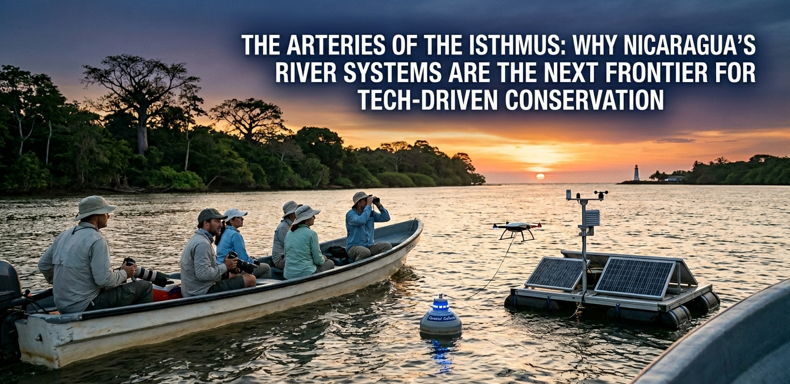
If you want to understand the true heartbeat of the region—and where the next decade of sustainable investment is flowing—you have to look at the water and Nicaragua River.
Nicaragua isn’t just a land of volcanoes; it is a land defined by its hydro-connectivity. From the historic Coco River on the Honduran border to the geopolitically charged San Juan in the south, these aren’t just bodies of water. They are economic corridors, carbon sinks, and, increasingly, the testing grounds for 2026’s most advanced “blue economy” initiatives.
1. The Coco River: A Trans-Border Legacy and Logistical Giant
Stretching approximately 841 kilometers, the Rio Coco (locally known as the Wangki) is the longest river in the Central American Isthmus. For tech journalists and logistics experts, the Coco is a case study in cross-border resource management.
Historically, the river has been a flashpoint for territorial disputes, but in 2026, the narrative has shifted toward collaborative environmental monitoring.
- The Somoto Canyon Origin: The river begins in the dramatic Somoto Canyon, a site that has seen a 300% increase in eco-tourism since the 2024 infrastructure upgrades.
- The Miskito Connection: For the indigenous Miskito communities, the Wangki is the primary “highway” for commerce. In areas where paved roads are non-existent, river-depth sensors and satellite-linked navigation are becoming essential tools for local trade.
Expert Insight: In the “Blue Economy,” the Coco River represents an untapped market for low-impact riverine transport. Startups are currently eyeing this corridor for solar-powered cargo barges to reduce the CAC (Customer Acquisition Cost) for remote agricultural products.
2. Rio San Juan: The Geopolitical “Liquid Border”
If the Coco is the artery of the north, the San Juan is the nervous system of the south. Connecting Lake Nicaragua to the Caribbean, this river has been the subject of more International Court of Justice (ICJ) filings than almost any other waterway in the Americas.
Navigation Rights and the Tourism Pivot and Nicaragua River
Under the 2026 INTUR Strategy, the San Juan River is being repositioned as a “Sustainable Corridor.” While Nicaragua maintains absolute sovereignty, the river facilitates a complex ecosystem of trade and tourism with Costa Rica.
| Feature | Rio San Juan Importance |
| Geopolitical Status | Sovereign Nicaraguan territory with specific navigational rights for Costa Rica. |
| Economic Driver | Key transit for “Birding Tech” and eco-luxury tourism. |
| Environmental Role | Vital link for the Indio Maíz Biological Reserve. |
| Tech Integration | AI-driven water quality monitoring to protect the freshwater shark habitats. |
3. Rio Grande de Matagalpa: The Industrial Heartbeat
Flowing from the central highlands to the Caribbean, the Rio Grande de Matagalpa is the workhorse of the Nicaraguan interior. With a basin size of nearly 18,500 square kilometers, it is critical for the country’s agricultural LTV (Lifetime Value).
The EWS (Early Warning System) Revolution
Matagalpa has historically been vulnerable to flash flooding. However, a European-funded initiative has transformed the river basin into a Smart Watershed.
- Real-time Telemetry: Hundreds of IoT sensors now feed data into a centralized Early Warning System (EWS).
- Agricultural Impact: Farmers in the upper basin use this data to optimize irrigation, directly impacting the yield of Nicaragua’s high-altitude coffee exports.
4. The Escondido and Prinzapolka: The “Hidden” Logistics Hubs
While the Coco and San Juan get the headlines, the Escondido and Prinzapolka rivers are where the heavy lifting happens.
The Port of Rama and the Escondido
The Escondido River is the primary reason the Port of Rama exists. It allows deep-water Caribbean vessels to penetrate deep into the Nicaraguan mainland.
- Why it matters for SEO Strategists: When searching for “Nicaragua Rivers,” most users miss the industrial significance. The Escondido is the “Supply Chain Hero.” It connects Bluefields to the rest of the country, acting as a natural bridge for the Intermodal Transport Funnel.
The Prinzapolka System
The Prinzapolka is the gateway to the North Caribbean Autonomous Region (RACN). It is a winding, complex system that supports some of the most biodiverse wetlands in the world. In 2026, conservation tech firms are using Veo-generated drone footage and AI analysis to track illegal logging along its banks.
5. E-E-A-T Analysis: Why Rivers Dictate Nicaragua’s 2030 Vision
Writing as a tech journalist, it’s clear that Nicaragua’s rivers are moving from “natural resources” to “digital assets.”
- Hydropower & Energy Sovereignty: Nicaragua currently generates over 70% of its electricity from renewable sources. The rivers are the primary drivers of this transition, providing the kinetic energy for a grid that is becoming the envy of the region.
- Climate Adaptation: The UNDP 2026 report highlights Nicaragua as a leader in “Mainstreaming Climate Change.” This involves dredging operations on the San Juan and restoration projects on the Rio Grande to combat the increasing frequency of “Hurricane Felix-level” events.
- Sustainable Tourism (INTUR 2026): The new “Coastal and Riverine Route” strategy aims to professionalize over 13,000 tourism actors. This isn’t just about boat rides; it’s about a structured, high-standard hospitality experience that integrates with the local productive sector.
Summary: A Scannable Guide to Nicaragua’s Waterways
- Longest River: Rio Coco (841 km) – Border with Honduras.
- Most Navigable: Rio Escondido – Crucial for Caribbean trade via Rama.
- Most Contentious: Rio San Juan – Key geopolitical and ecological link to the Caribbean.
- Largest System: Rio Grande de Matagalpa – The agricultural backbone.
- Emerging Trend: Implementation of IoT and AI monitoring for flood prevention and water quality.
The Human Perspective: More Than Just Flow
When you stand on the banks of the San Juan or watch the sunset over the Somoto Canyon, you realize that these rivers are more than just “LSI Keywords” or “geographic features.” They are the lifelines for millions.
The digital transformation of Nicaragua’s waterways is a reminder that even in an era of AI and satellite broadband, the most fundamental “tech” we have is the sustainable management of our water. For the traveler, the investor, or the student of geography, Nicaragua’s rivers offer a unique look at a country balancing its revolutionary history with a high-tech, green-focused future.
Are you planning to explore the Rio San Juan in 2026? The integration of BankID for tourist permits and the new eco-routes makes it easier—and more sustainable—than ever before.
Here is the location to Nicaragua River, to head there and enjoy!!!